Wooden Shoe Rack Ideas: 19 Warm, Space-Saving Ways to Organize Your Entryway
Stepping over a pile of sneakers, damp rain boots, and scattered sandals right inside the front door makes even the most thoughtfully decorated home feel chaotic. While plastic bins and flimsy wire tiers often look like temporary dorm-room fixes, the right wooden shoe rack ideas treat footwear storage like real furniture. Natural timber brings organic warmth, architectural structure, and visual calm to hard entryway floors—turning a high-traffic drop zone into an intentional, welcoming part of your home decor.
Whether you are working with a 38-inch apartment hallway, a boxy foyer corner, or an open-plan living room entrance, finding a smart wooden shoe rack for entryway organization adapts to your exact architectural footprint. By matching the right wood species, shelf depth, and airflow design to your daily routine, you can corral everyday footwear without sacrificing precious walking space.
Essential Sizing, Wood Species & Clearance Rules for Wooden Shoe Racks
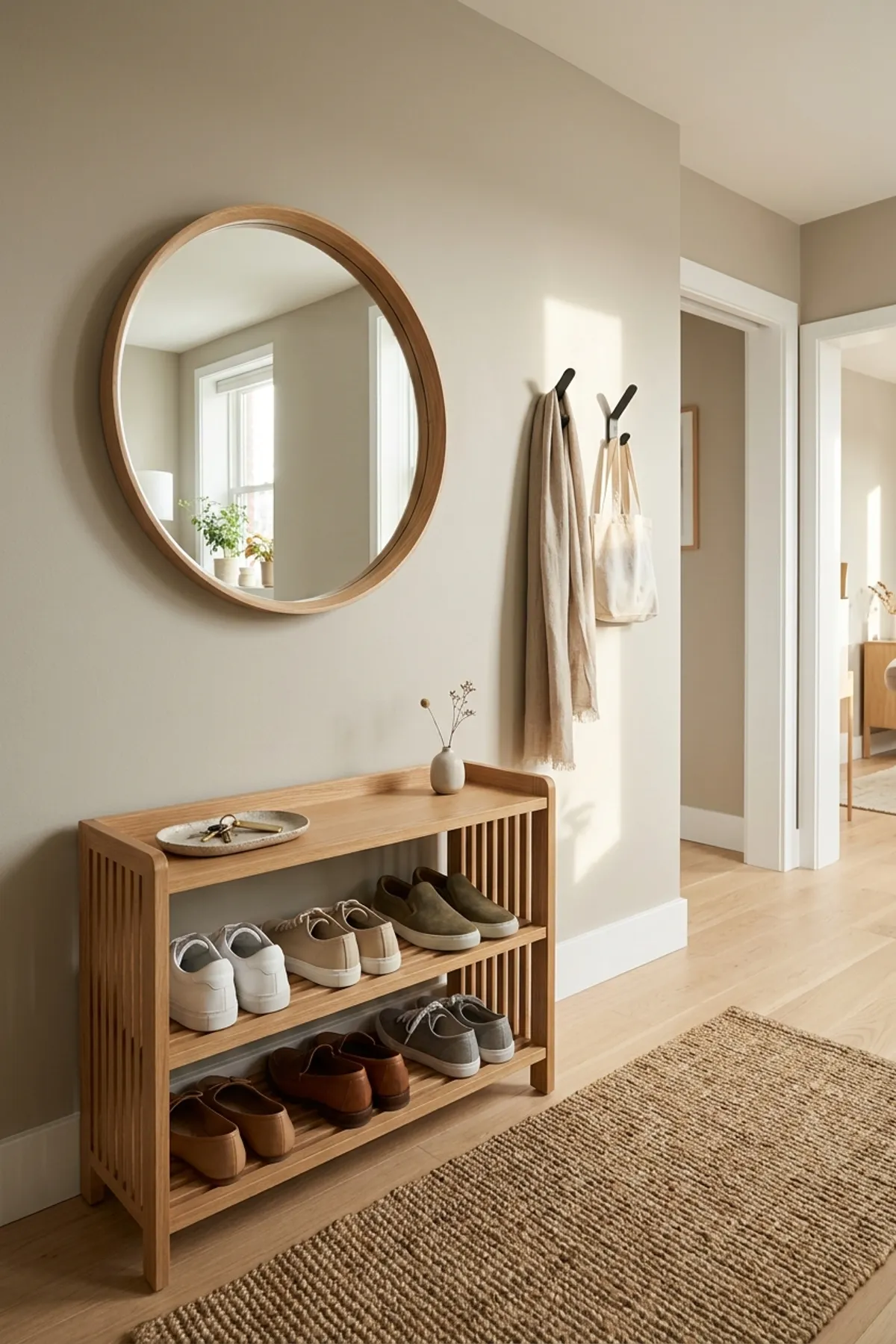
Before purchasing or building an entryway shoe storage system, measure both your hallway pinch points and the largest shoes in your household. Two inches of miscalculated shelf depth or the wrong wood finish can lead to scuffed walls, blocked doorways, or warped timber. (If your circulation space is exceptionally narrow, check our companion guide to tiny hallway ideas for stretching tight corridors.)
- Minimum Unobstructed Walkway: Always preserve 32 to 36 inches of clear floor path in front of your shoe rack—aligning with the U.S. Access Board ADA clear walkway standards—so household members can walk past comfortably without tripping or brushing against the shelves.
- Shelf Depth by Storage Style:
- Flat Horizontal Slatted Racks (11.5 to 13 inches deep): A US Men’s Size 10 or 11 athletic shoe measures 11.5 to 12.5 inches long. If your flat rack is only 10 inches deep, heels or toes will overhang the front ledge and catch on passersby.
- Angled Ladder or Slanted Racks (9 to 10.5 inches deep): Storing shoes on a 25-to-30-degree slant equipped with a rear heel stop shortens the horizontal footprint while comfortably accommodating longer adult footwear.
- Tilt-Out Closed Wood Cabinets (6.5 to 9 inches deep): Ideal for small entryway shoe storage in corridors under 42 inches wide because shoes sit vertically inside pull-down compartments.
- Horizontal Width & Pair Capacity: Allow 8 to 9 inches of shelf width per pair of adult shoes (or 6 inches for children’s shoes). A standard 28- to 30-inch-wide tier holds 3 pairs of adult shoes neatly side-by-side; a 36-inch-wide tier holds 4 pairs.
- Vertical Tier Spacing: Space standard shelves 5.5 to 6.5 inches apart for low-profile sneakers, loafers, and flats; allow 8 to 10 inches for ankle boots or high-tops; and reserve a 14- to 17-inch top tier or open side bay for tall rain or winter boots.
- Best Wood Species & Moisture Protection: Entryways endure wet soles, winter road salt, and humidity. According to timber density benchmarks documented in The Wood Database, high-density hardwoods like White Oak (1,360 Janka rating), Ash (1,320 Janka), and Acacia (1,750 Janka)—as well as sustainable sealed bamboo—resist daily denting and moisture absorption far better than softwoods. Always choose timber finished with a water-resistant matte polyurethane or hardwax oil coat. Avoid raw, unsealed pine or cheap paper-laminated particleboard, which swells and bubbles when exposed to damp shoes.
Quick Wins for a Tidy Wooden Shoe Organizer
Apply these foundational principles to make any wooden shoe organizer look cleaner and work harder right away (and review our comprehensive blueprint for small space entryway organization to coordinate your entire arrival zone):
- Prioritize slatted shelves for daily sneakers: Open wooden slats allow 360-degree airflow under damp soles so everyday footwear dries quickly without trapping odors or moisture.
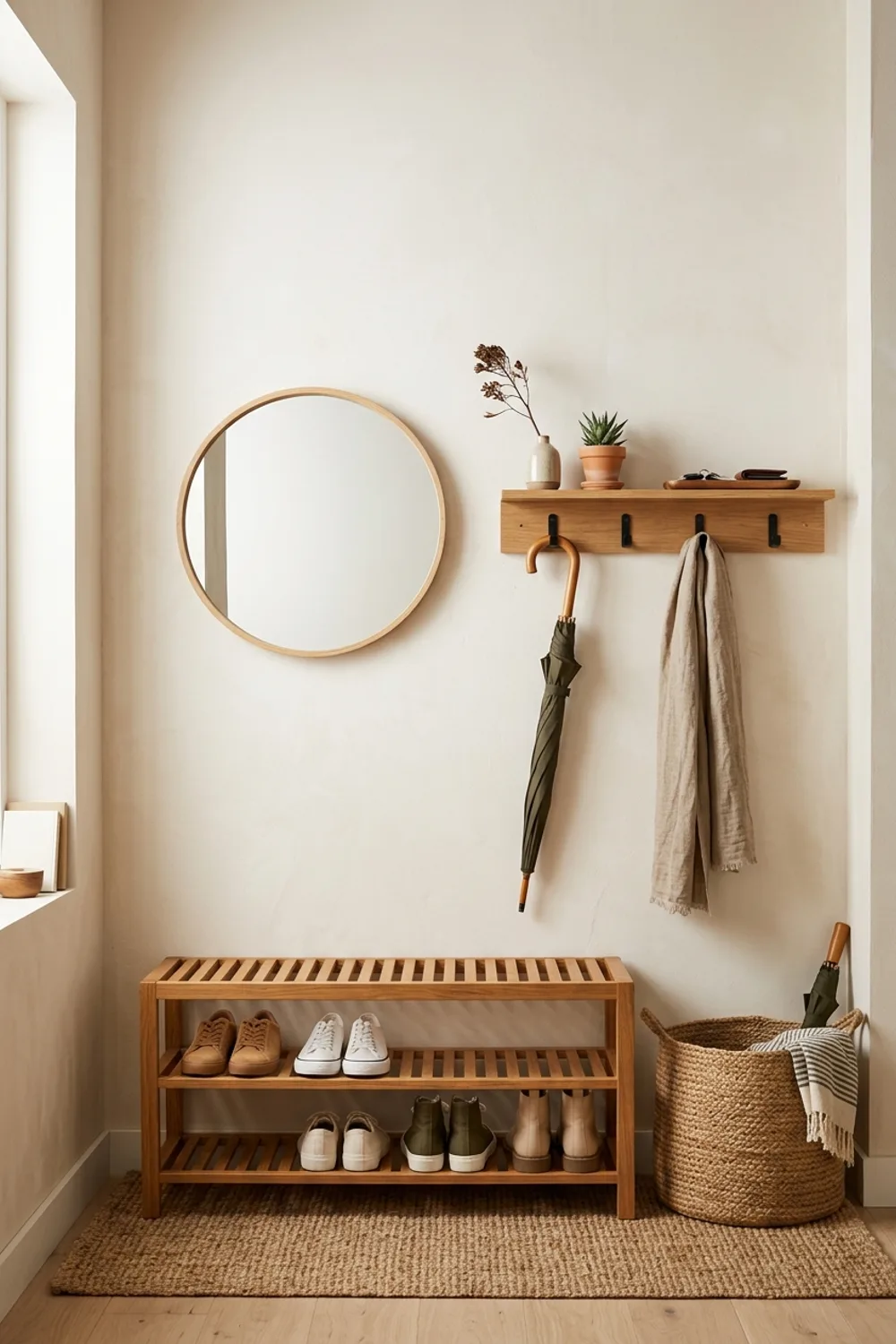
- Echo your wood undertone once above eye level: Repeat the timber tone of your shoe rack—whether pale white oak, warm honey ash, or rich walnut—in a mirror frame or wall hook rail above it so the setup reads as a unified vignette.
- Enforce an active-rotation limit: Keep only 6 to 10 pairs of everyday shoes by the front door; move special-occasion heels, workout gear, and off-season boots to dedicated shoe closet organizers.
- Corral tiny footwear in a side basket: Toddler shoes, flip-flops, and indoor slippers slip through open wooden slats—drop them into a single structured seagrass basket beside or on the bottom shelf of the rack.
- Keep the top surface 60% bare: If your shoe rack has a solid wood top, style it with just one ceramic key bowl and one small vertical accent so it never looks like a cluttered shelf.
19 Wooden Shoe Rack Ideas for Organized Entryways
1. Low Two-Tier Open Slatted Oak Rack for Airy Sightlines
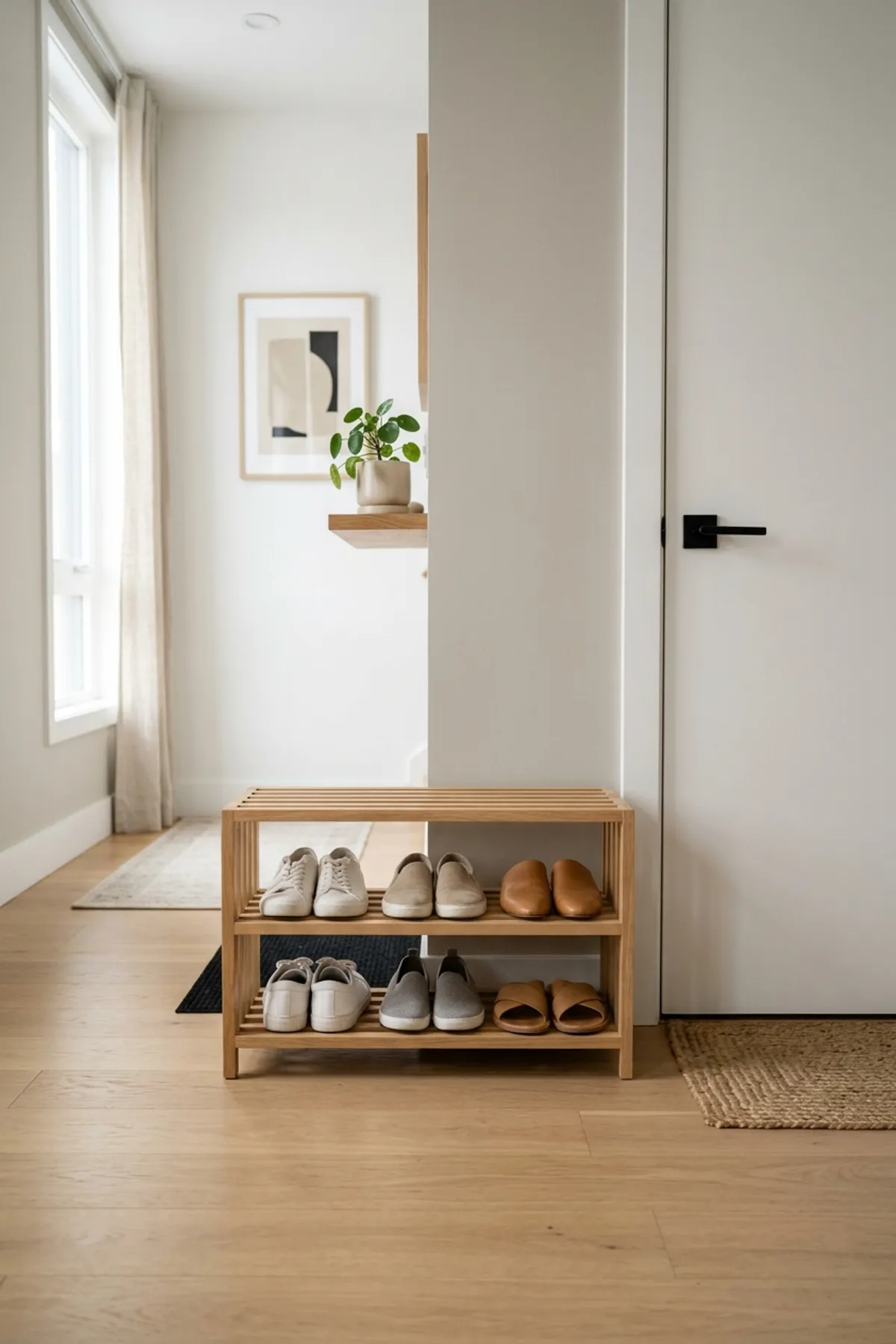
In a compact apartment entrance where bulky cabinetry makes the walls feel like they are closing in, a low two-tier open slatted white oak rack (14 to 16 inches tall by 12 inches deep) keeps the visual weight close to the floor. (If you are starting from scratch in a tight foyer, browse our foundational guide to small entryway ideas for first-apartment setups.)
Why This Works Visually: Open slats let ambient light pass through the shelves and leave the baseboard and wall behind the rack visible, making a tight foyer feel noticeably wider.
Interior Stylist Tip: Leave 3 to 4 inches of clear floor space under the bottom stretcher so you can sweep dust bunnies easily and let your entryway runner show underneath.
2. Angled Ladder-Style Wood Rack for Tight Hallways
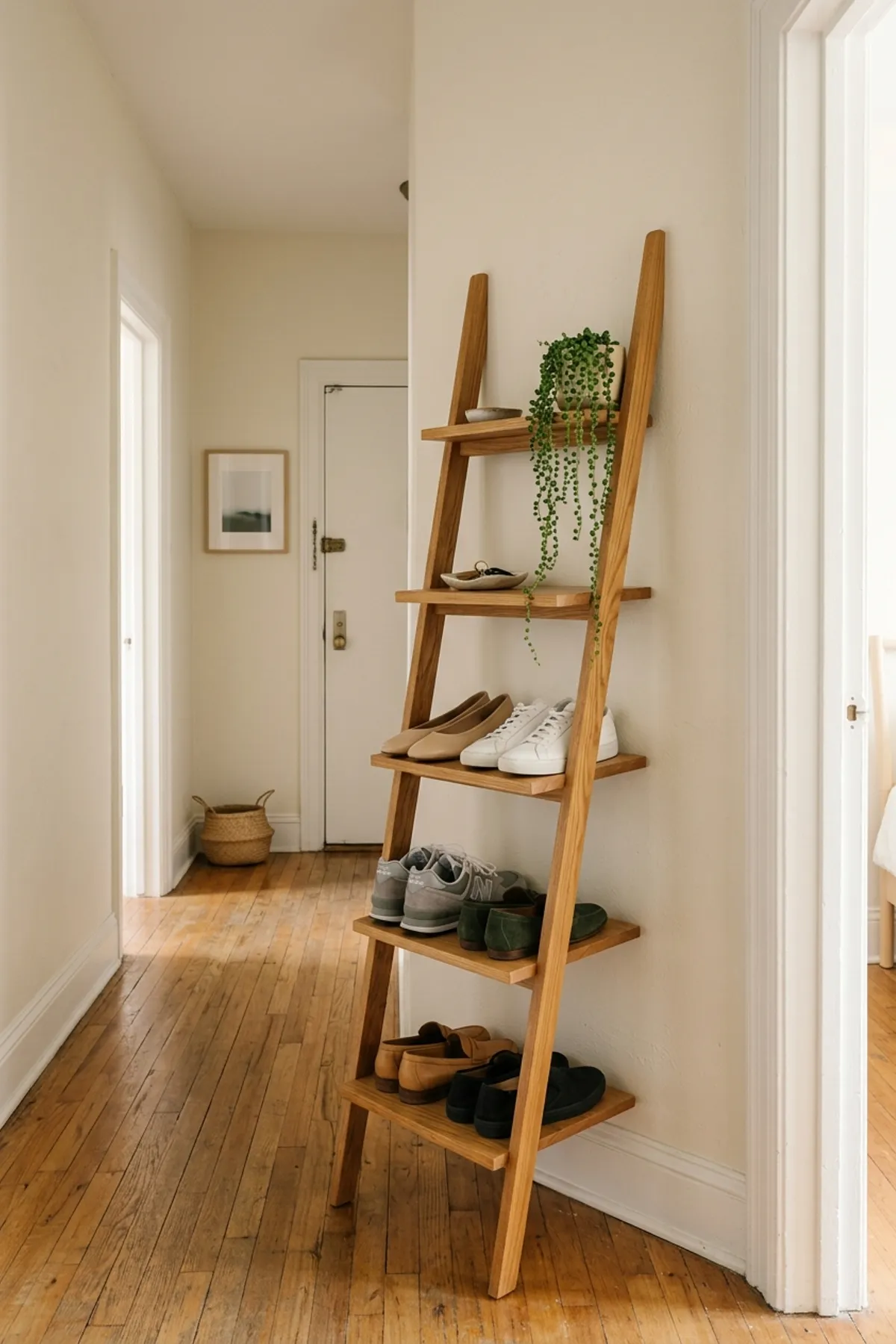
When your front door opens into a narrow corridor where a 13-inch-deep horizontal rack would block the walking path, lean or secure a ladder-style wooden rack with angled slatted shelves (9.5 to 10.5 inches deep) against the wall. Among popular narrow shoe rack ideas, this slanted configuration provides maximum shoe capacity in minimum floor depth. (Explore more spatial clearance tricks in our companion guide to narrow entryway ideas.)
Why This Works Visually: The tapered side rails get slimmer as they rise toward eye level, preserving shoulder room in narrow passages while holding 8 to 10 pairs of shoes at an angle.
Actionable Tip: Reserve the narrowest top rung of a ladder rack for a small ceramic key dish, folded sunglasses, and a trailing pothos plant so the piece finishes at a decorative point.
3. Cushioned Wooden Shoe Bench for Seated Comfort
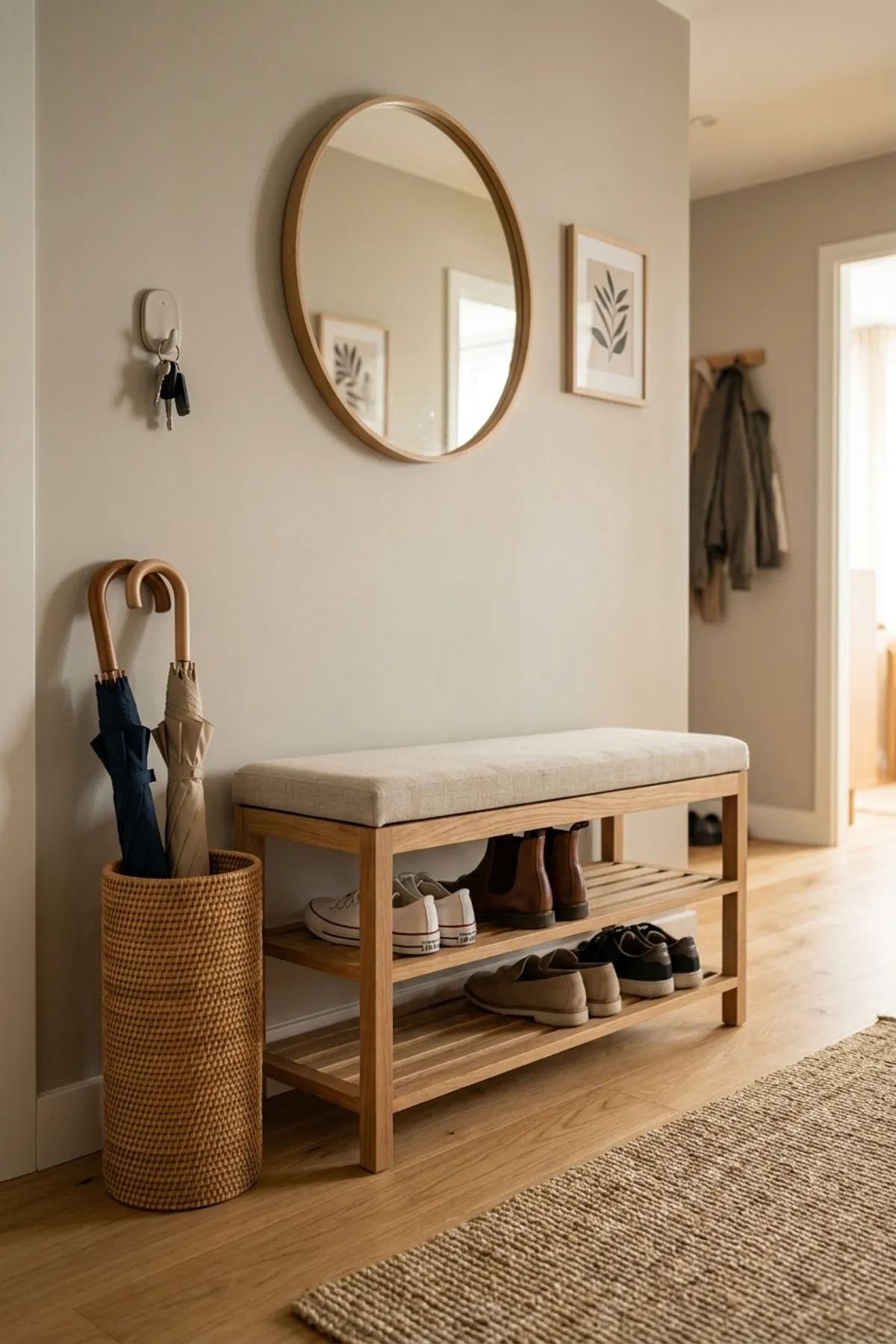
Balancing on one foot while wrestling with boot laces quickly leads to scuffed walls. A solid oak or rubberwood wooden shoe bench storage piece (17 to 18 inches high and 32 to 36 inches wide) combines two lower slatted shoe tiers with a sturdy seat topped by a 1.5-inch tailored linen cushion. For alternative flip-down and drawer designs, browse our guide to an entryway bench with shoe storage.
Why This Works Visually: The removable fabric cushion softens the rigid geometry of wooden slats and makes the entrance feel welcoming, cozy, and residential.
Actionable Tip: Choose a seat cushion cover with a hidden zipper in washable performance linen or indoor-outdoor canvas so street dust and indigo dye transfer wash right out.
4. Tall Vertical Wooden Cubby Tower for Narrow Wall Strips
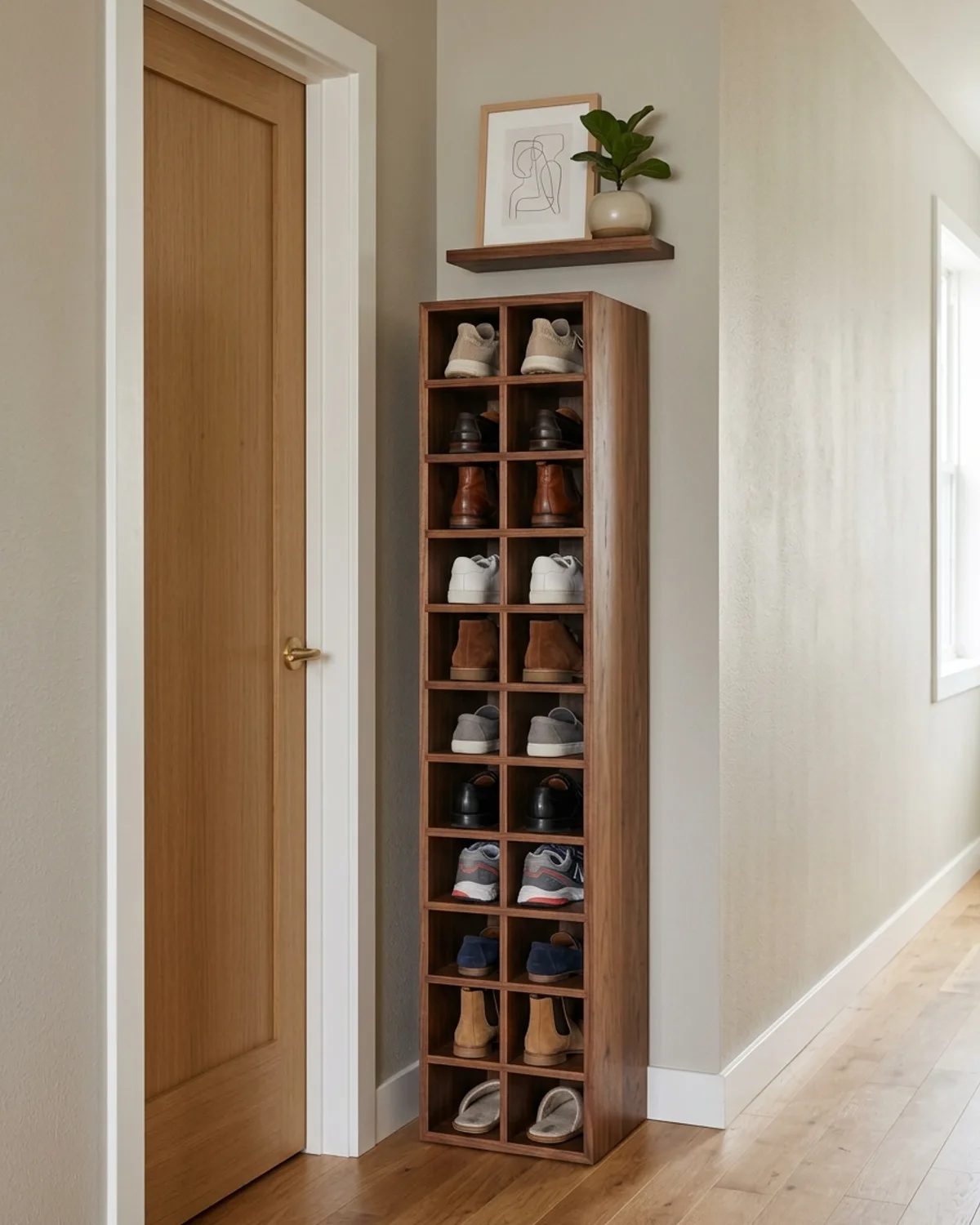
When you only have a 12- to 16-inch strip of wall between your doorframe and an intersecting closet door, horizontal shoe racks are out of the question. Swap width for height with a freestanding vertical wooden cubby tower (12 inches wide by 48 to 60 inches tall) featuring six to eight individual stacked slots.
Why This Works Visually: Stacking pairs vertically in crisp walnut or ash cubbies creates architectural rhythm while occupying just one square foot of floor area.
Renter-Friendly Tip: Secure the top of a tall narrow tower to the drywall using a single removable adhesive furniture strap or small L-bracket so it never wobbles on uneven floorboards.
5. Wall-Mounted Floating Wood Shoe Shelf
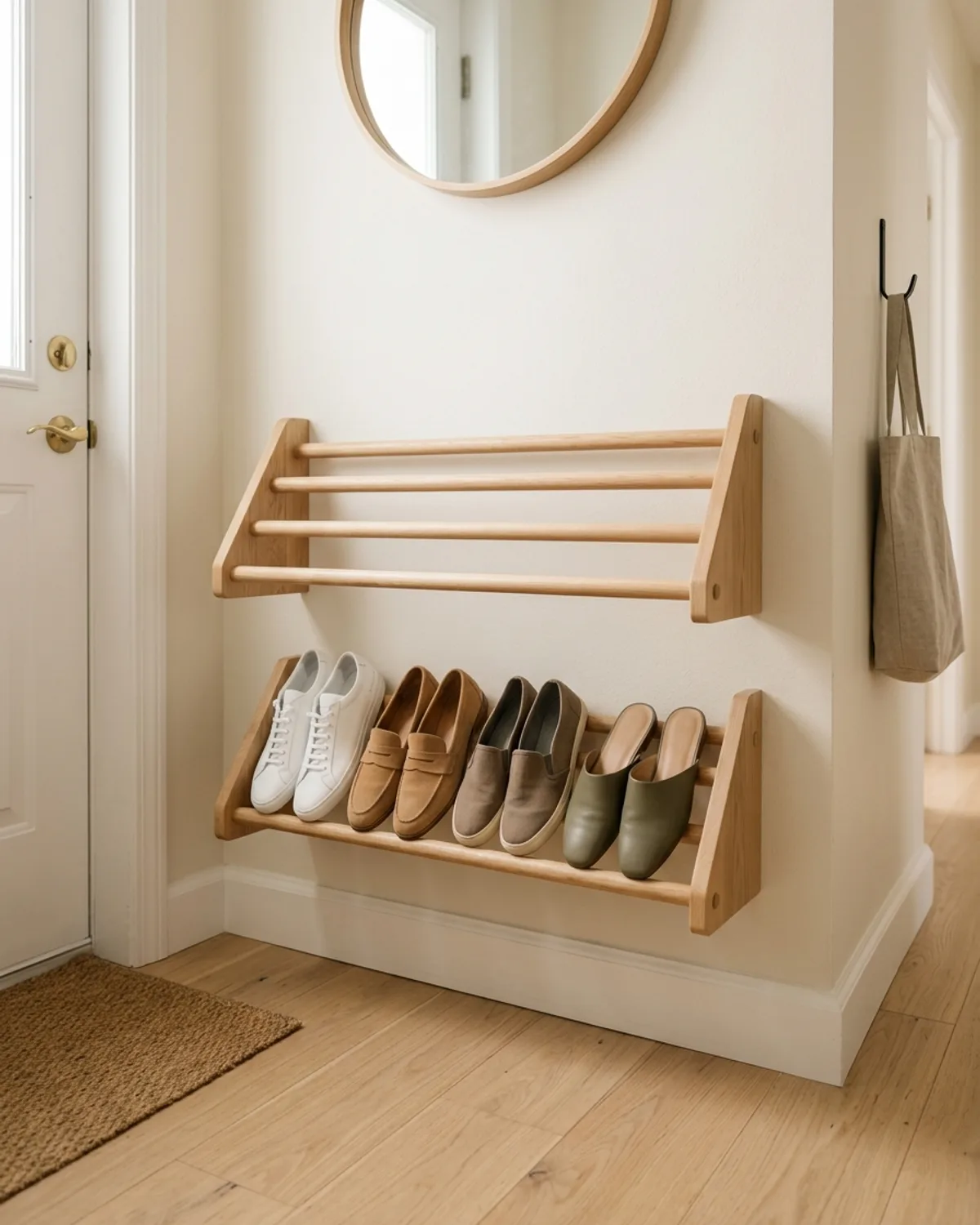
Nothing makes a tiny entrance hall feel bigger than keeping 100% of the floor unobstructed. Mount one or two floating solid wood shoe shelves or slotted wooden dowel racks 6 to 8 inches off the floor into wall studs.
Why This Works Visually: Seeing the hardwood floor or tile run continuously to the baseboard underneath the floating rack eliminates visual clutter and makes vacuuming effortless.
Actionable Tip: Space two stacked floating shelves 7 inches apart, leaving the floor directly underneath open for sliding in flat indoor house slippers.
6. Coordinated Wood Shoe Rack and Shaker Peg Rail System
A lone shoe rack sitting at ankle height against a tall blank wall can look disconnected. Turn a flat wall into a cohesive arrival zone by mounting a matching wooden shaker peg rail at 62 inches high directly above your floor shoe rack.
Why This Works Visually: Matching the timber tone at the floor and at eye level frames the wall vertically, keeping coats, tote bags, and shoes neatly aligned in one column.
Designer Trick: You do not need an exact factory wood match—pairing a warm white oak shoe rack with a natural ash or birch peg rail looks curated as long as both pieces share a warm matte finish.
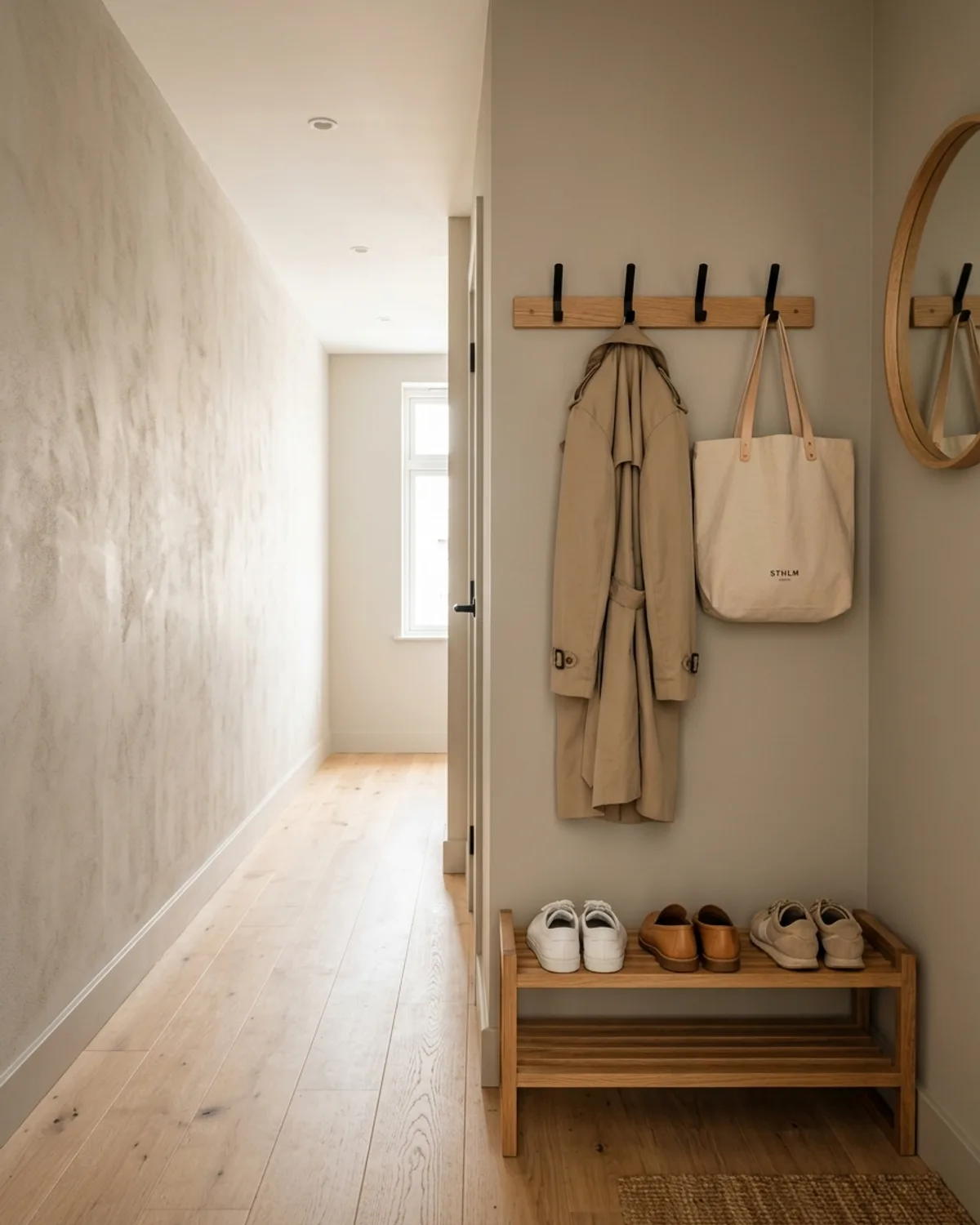
7. Quarter-Round Corner Wooden Rack for Dead Nooks
The 90-degree corner behind an inward-swinging front door or beside a radiator is often wasted space. Tucking a three- or four-tier quarter-round or triangular wooden corner rack (12 to 14 inches along each wall edge) into that pocket stores 4 to 6 pairs of daily shoes completely out of the main traffic lane.
Why This Works Visually: Curved or angled front shelves soften sharp drywall corners and leave your primary foyer wall free for an oversized mirror.
8. Low Wooden Shoe Rack Tucked Beneath a Slim Console Table
If you already love the styled look of a narrow entryway console table for lamps and mail, utilize the dead space between the table legs. Slide a low, single- or double-tier wooden shoe rack (12 to 14 inches tall) directly beneath a 30-inch-high open-leg console table. (Find more console styling ideas in our small entrance hall ideas guide.)
Why This Works Visually: The console table frame acts as a visual shield that draws the eye upward to your mirror and tabletop vignette, while the wooden rack below quietly corrals footwear off the floor.
Interior Stylist Tip: Keep the console table legs and the lower shoe rack in either matching wood tones or a crisp black-metal-and-oak pairing so the two pieces look like a single custom unit.
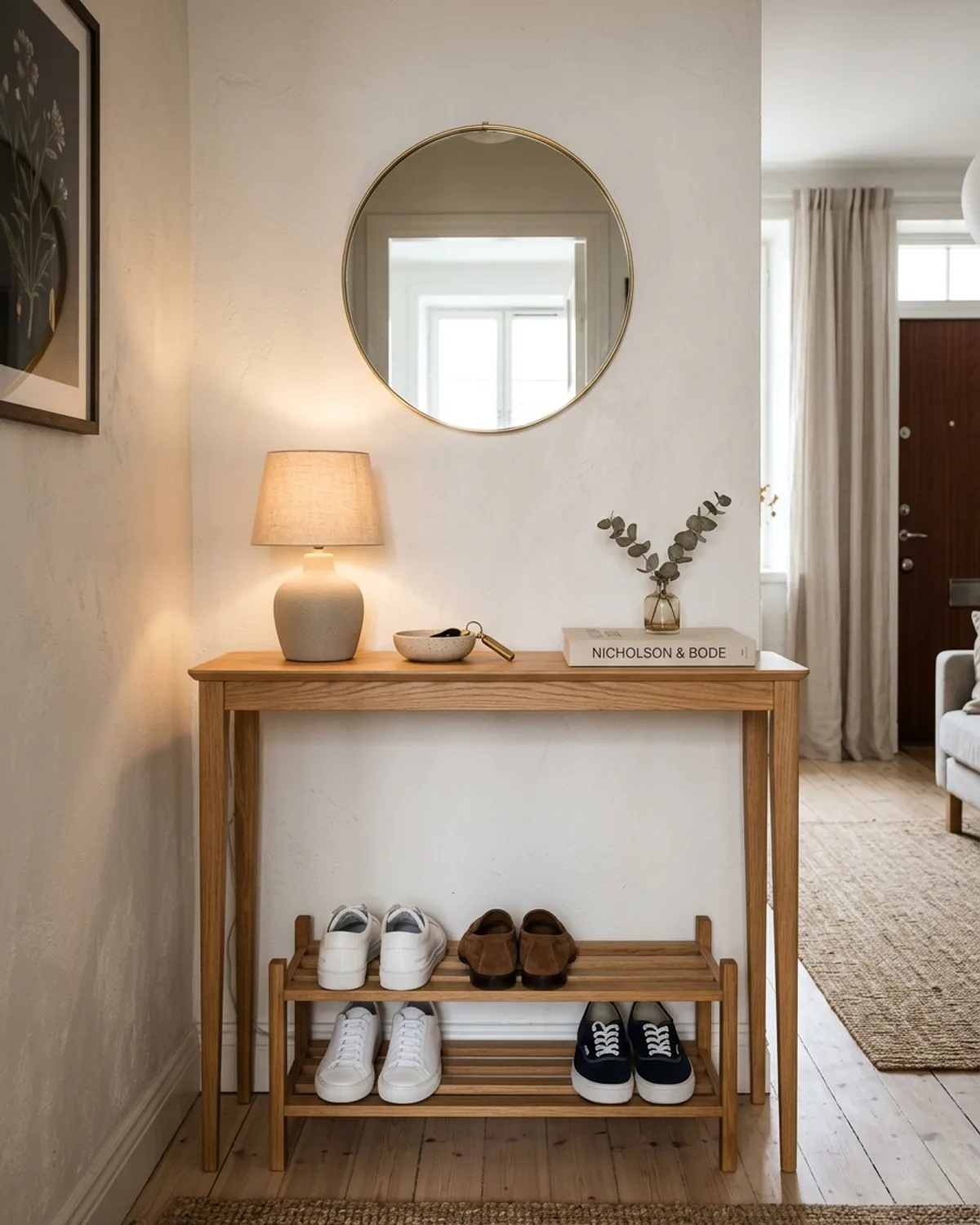
9. Breathable Cane-Front Wooden Shoe Cabinet
In open-plan apartments where the front door is visible from the dining table or sofa, open shoe racks can feel too casual. As one of the top wood shoe cabinet ideas, a shallow timber unit (11 to 13 inches deep) fitted with woven rattan cane-webbing doors hides colorful footwear while letting air circulate freely through the natural mesh.
Why This Works Visually: Cane panels replace busy shoe clutter with warm, woven organic texture that blends seamlessly with living room furniture.
Actionable Tip: Choose a cabinet elevated on 5-inch tapered wooden legs rather than a solid flush plinth base so the piece retains an airy, mid-century silhouette.
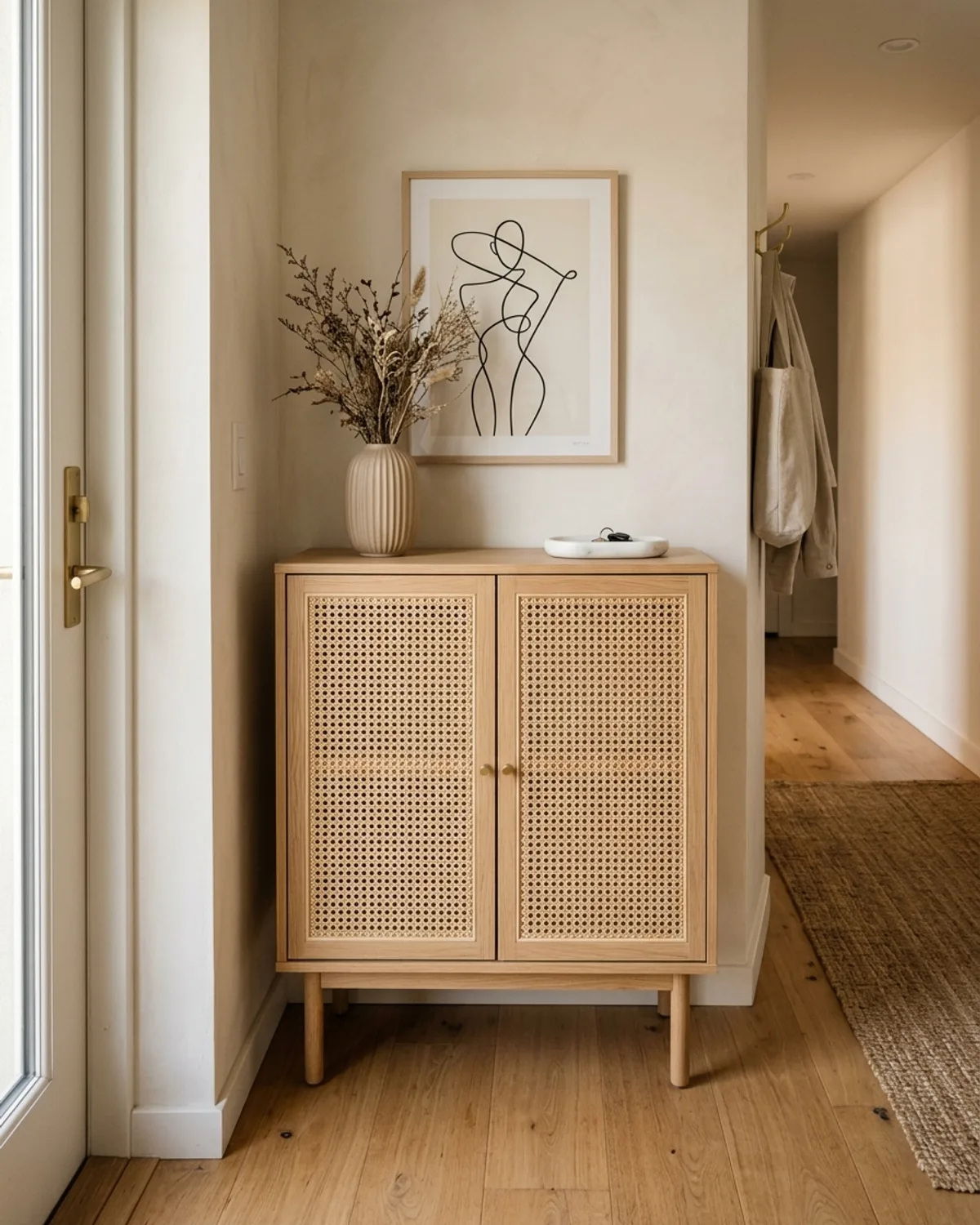
10. Modular Stackable Wooden Crate Racks for Renters
Apartment layouts change every time you move, making fixed built-ins impractical for renters. Interlocking solid pine or acacia crate-style shoe modules can be stacked four tiers high in a narrow studio hallway, or split into two low side-by-side benches in a wider foyer later.
Why This Works Visually: Positioning crates both horizontally (for low sneakers) and vertically (for tall boots or umbrella storage) creates an asymmetric, custom-shelving look.
Budget-Friendly Swap: Sand raw hardware-store wooden crates with 220-grit sandpaper, wipe on a coat of matte Danish oil or provincial wood stain, and clip them together at the back corners with small black binder clips or brass screws so they never shift.
11. Industrial Matte-Black Steel and Walnut Slatted Rack
In modern lofts or apartments with dark window frames and contemporary hardware, an all-wood rack can sometimes feel too rustic. A shoe rack built with 0.75-inch matte black powder-coated steel framing and rich walnut or smoked oak slatted shelves bridges warmth and sharp architectural contrast.
Why This Works Visually: Thin black metal uprights echo modern door hardware and mirror frames while the warm walnut shelves keep the entryway from feeling cold or utilitarian.
12. Mini-Mudroom Wooden Rack with Woven Basket Drawers
Everyday entryways collect more than just shoes—dog leashes, wool scarves, bike helmets, and reusable grocery bags need a home too. Choose a three-tier wooden rack where the bottom two tiers hold footwear and the top shelf holds two matching woven seagrass or canvas baskets.
Why This Works Visually: Containing small loose accessories inside matching baskets above the shoes keeps the rack looking structured, intentional, and tidy.
13. Stepped Stadium-Style Wooden Display Rack
Standard deep shelves often leave back-row shoes lost in dark shadows. A stair-stepped wooden rack—where each rear tier rises 3 to 4 inches higher than the tier in front of it—gives every pair clear visibility and easy grab-and-go access.
Why This Works Visually: The terraced profile mimics retail display architecture, turning a neat collection of clean white leather sneakers, loafers, and mules into an intentional design feature.
14. Reclaimed Barnwood Rack for Tactile Character
New-build rental apartments with flat white drywall and gray laminate flooring can feel sterile right inside the door. Introducing a compact bench or two-tier shoe rack crafted from kiln-dried, sanded reclaimed oak or elm adds instant patina, visible grain, and warmth. (If your front door opens into your primary seating area, explore our guide to living room nook ideas for harmonizing entry storage with living room decor.)
Why This Works Visually: The rich tonal variation of weathered timber hides minor scuffs and dirt marks from shoe soles far better than glossy painted white furniture.
Designer Trick: Balance rustic wood texture with crisp modern accents—like a thin frameless round mirror and a sleek black metal key tray—so the entryway reads modern-organic rather than heavy country farmhouse.
15. Low Pale-Ash Japandi Rack with Dowel Spindles
Inspired by traditional Japanese genkan entryways and Scandinavian minimalism, a low-slung shoe rack crafted from pale ash, birch, or bleached white oak with cylindrical wooden dowel bars creates an ultra-serene threshold.
Why This Works Visually: Rounded wooden dowels eliminate sharp corners, reflect scarce hallway light, and keep the profile under 12 inches tall so the upper wall remains completely open and calm.
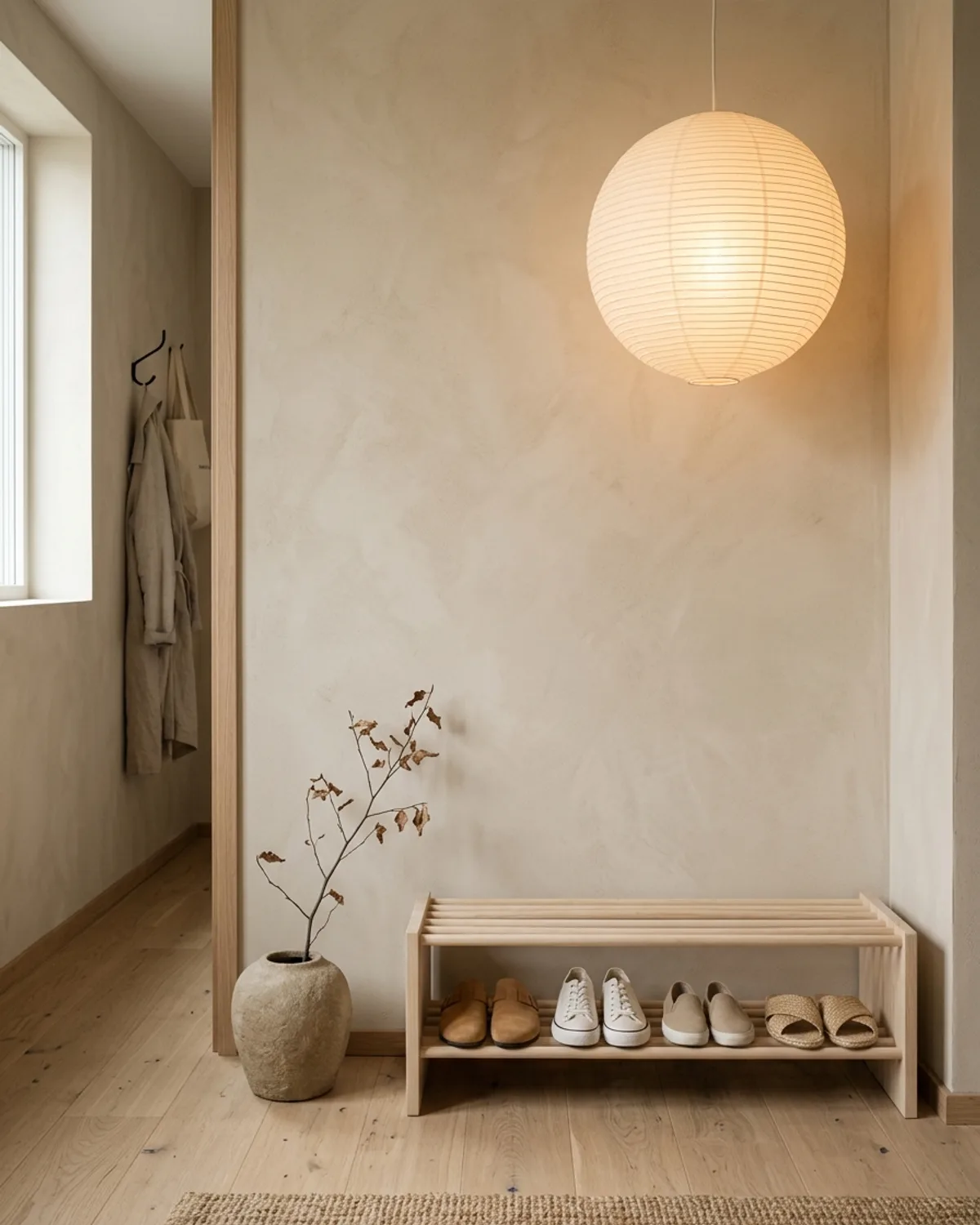
16. Family Cubby Station with Assigned Personal Slots
In a household of three or four people, a single open shelf quickly turns into a pile of stacked shoes. A wooden cubby organizer divided into an 8- or 9-grid matrix lets you assign one horizontal row or two vertical cubbies to each family member.
Why This Works Visually: Grid dividers physically prevent shoes from sprawling into each other, and clip-on brass or leather bin tags make it obvious whose slot is overflowing.
17. Long, Shallow Wooden Shoe Ledge Beneath an Oversized Mirror
If your entrance wall is wide but your walkway is narrow, skip short, deep racks and install a long, shallow two-tier wooden rack (36 to 48 inches wide by 10 inches deep) centered directly beneath a 32-inch round or arched mirror.
Why This Works Visually: Extending the horizontal line of the wooden rack grounds the wall while the large mirror above bounces light across the narrow walkway, making the foyer feel both wider and taller.
18. Double-Sided Wooden Shoe Credenza as a Studio Room Divider
When your apartment front door opens straight into your main studio sleeping or living area with zero wall separation, place a medium-height open-back or finished-back wooden shoe credenza (28 to 32 inches tall) perpendicular to the wall right beside the door. (For broader open-plan storage solutions, explore our companion guide to apartment entryway storage ideas.)
Why This Works Visually: It builds an instant architectural “faux foyer” that blocks the view of front-door shoes from your bed or sofa without blocking natural window light.
Actionable Tip: Use the top surface of the divider rack as a shared landing strip—key bowl on the door side, small cordless lamp on the living room side.
19. Layered Custom-Look Entry Wall (Rack + Floating Shelf + Hooks)
You do not need a $3,000 custom carpenter built-in to get a designer mudroom look. Combine three affordable freestanding and wall-mounted pieces in the same warm oak finish: a two-tier wooden shoe rack on the floor, a row of matte black coat hooks mounted at 60 inches high, and a 6-inch-deep floating oak shelf mounted directly above the hooks at 68 inches high.
Why This Works Visually: Carrying the identical wood grain from floor to upper wall tricks the eye into reading three separate budget pieces as one cohesive, custom-designed millwork station.
Wooden Shoe Rack Comparison Matrix by Layout & Wood Tone
Use this quick decision table to select the ideal wooden rack style, timber species, and dimensions for your exact entryway:
| Entryway Layout / Need | Best Wooden Rack Style | Target Dimensions | Recommended Wood & Finish |
|---|---|---|---|
| Narrow Hallway (Under 42″ wide) | Angled ladder rack or tilt-out wood cabinet | 7″ – 10″ D × 24″ – 30″ W | Pale white oak or ash (light-reflective) |
| Fast Daily Family Access | 2-tier open slatted rack or grid cubbies | 12″ – 13″ D × 32″ – 36″ W | Sealed bamboo or durable rubberwood |
| Needs Seating + Shoe Storage | Cushioned wooden shoe bench | 12″ – 14″ D × 30″ – 36″ W × 18″ H | Solid oak or acacia (250+ lb load rating) |
| Visible from Living Room / Studio | Cane-front closed cabinet or divider rack | 11″ – 13″ D × 30″ – 36″ W | Warm walnut or medium oak + rattan cane |
| Tiny Corner or Dead Nook | Vertical cubby tower or quarter-round rack | 12″ × 12″ footprint × 48″ – 60″ H | Natural birch or walnut with wall tether |
| Easy Floor Cleaning / Minimalist | Wall-mounted floating dowel shelf | 10″ – 11″ D × 24″ – 36″ W (mounted 7″ up) | Matte hardwax-oiled ash or white oak |
Common Wooden Shoe Rack Mistakes to Avoid
Protect your floors, your footwear, and your walkway by avoiding these frequent entryway storage pitfalls:
- Placing dripping wet boots directly on raw or veneered wood: Standing water and winter road salt will warp unsealed wood and bubble MDF veneer within weeks. Always place a slim rubber boot tray underneath the bottom tier or choose water-resistant sealed bamboo or teak.
- Buying a rack that is too shallow for adult sneakers: Many budget decorative racks measure only 9 inches deep on flat shelves, causing adult shoes to jut out 3 inches into the hallway. Measure your longest pair of shoes before buying a flat horizontal rack.
- Cramming tall boots onto short shelves: Laying tall leather boots sideways across a 6-inch shelf creases the shafts and eats up three pairs’ worth of space. Buy a rack with a recessed side boot section or store tall boots on the top tier.
- Mixing four clashing wood tones in a tiny foyer: Pairing a cherry-red shoe rack with yellow-pine floors, a dark espresso mirror, and gray driftwood hooks creates visual chaos. Match your shoe rack either to your flooring undertone or to the mirror/hook trim above it.
Frequently Asked Questions
Conclusion
The best wooden shoe rack ideas do far more than clear sneakers off the floor—they bring natural warmth, architectural order, and effortless daily flow to the first room you see when you walk home. Whether you opt for a low pale-oak Japandi slatted rack, a narrow ladder shelf in a tight hallway, a breathable cane-front cabinet, or a cushioned storage bench, success comes down to choosing durable sealed timber scaled to your walkway clearance. Measure your entryway footprint today, pare down your front-door footwear to your true daily essentials, and pair your wooden rack with a mirror and hooks above for a calm, cohesive arrival space.